
TV Series · 2019
The Name of the Rose
Umberto Eco's abbey rebuilt over four thousand square metres at Cinecittà. The library, in two copies: one could be set on fire.
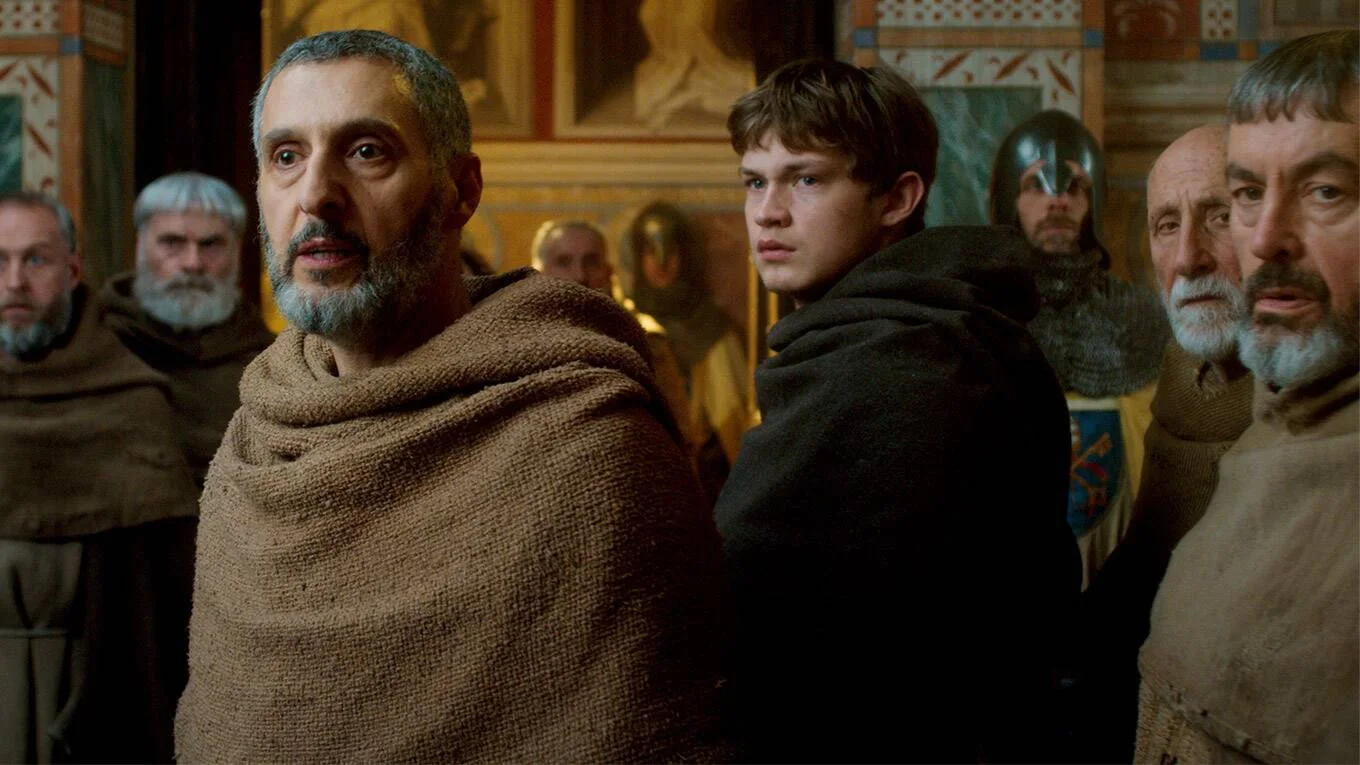
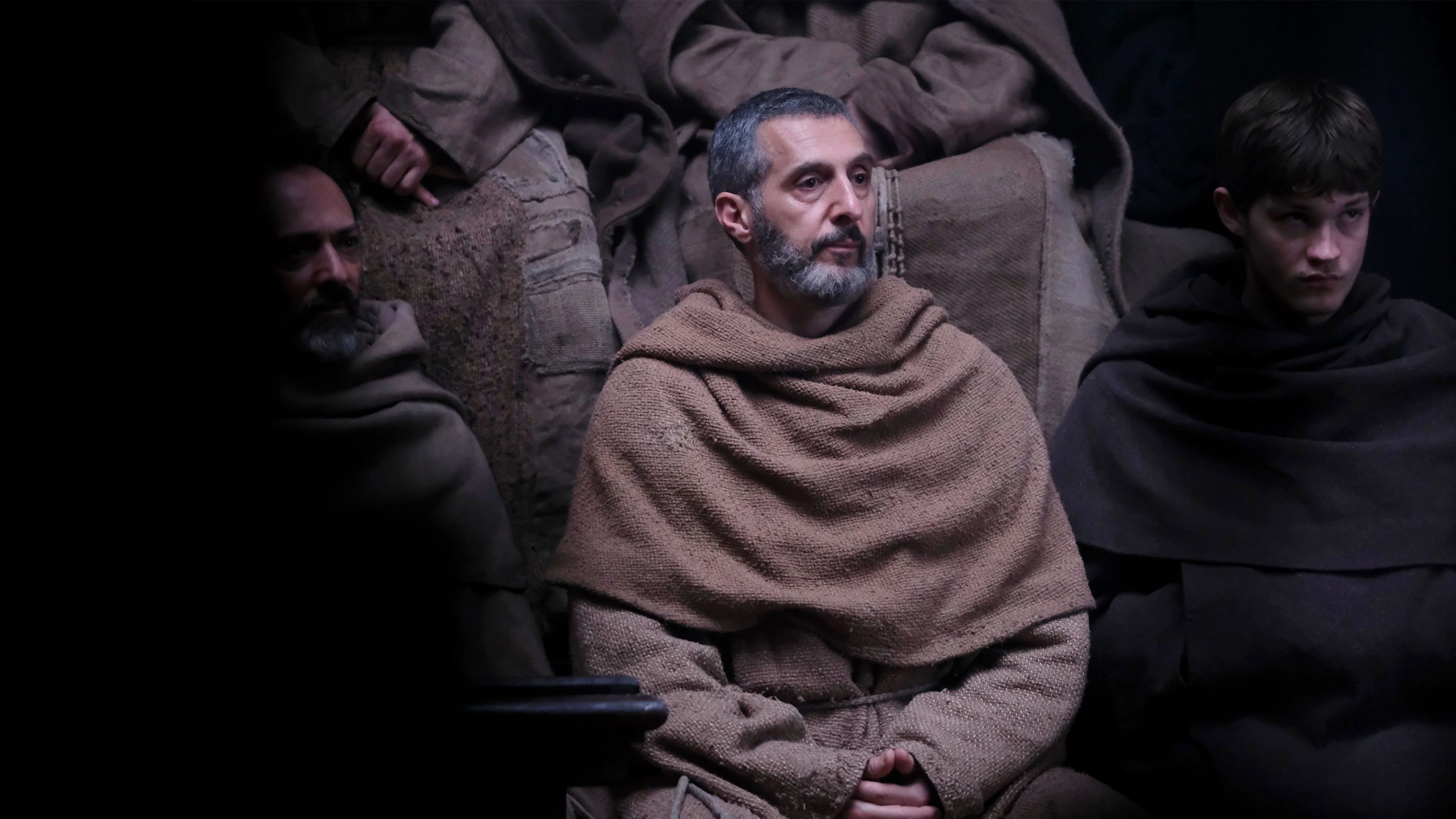
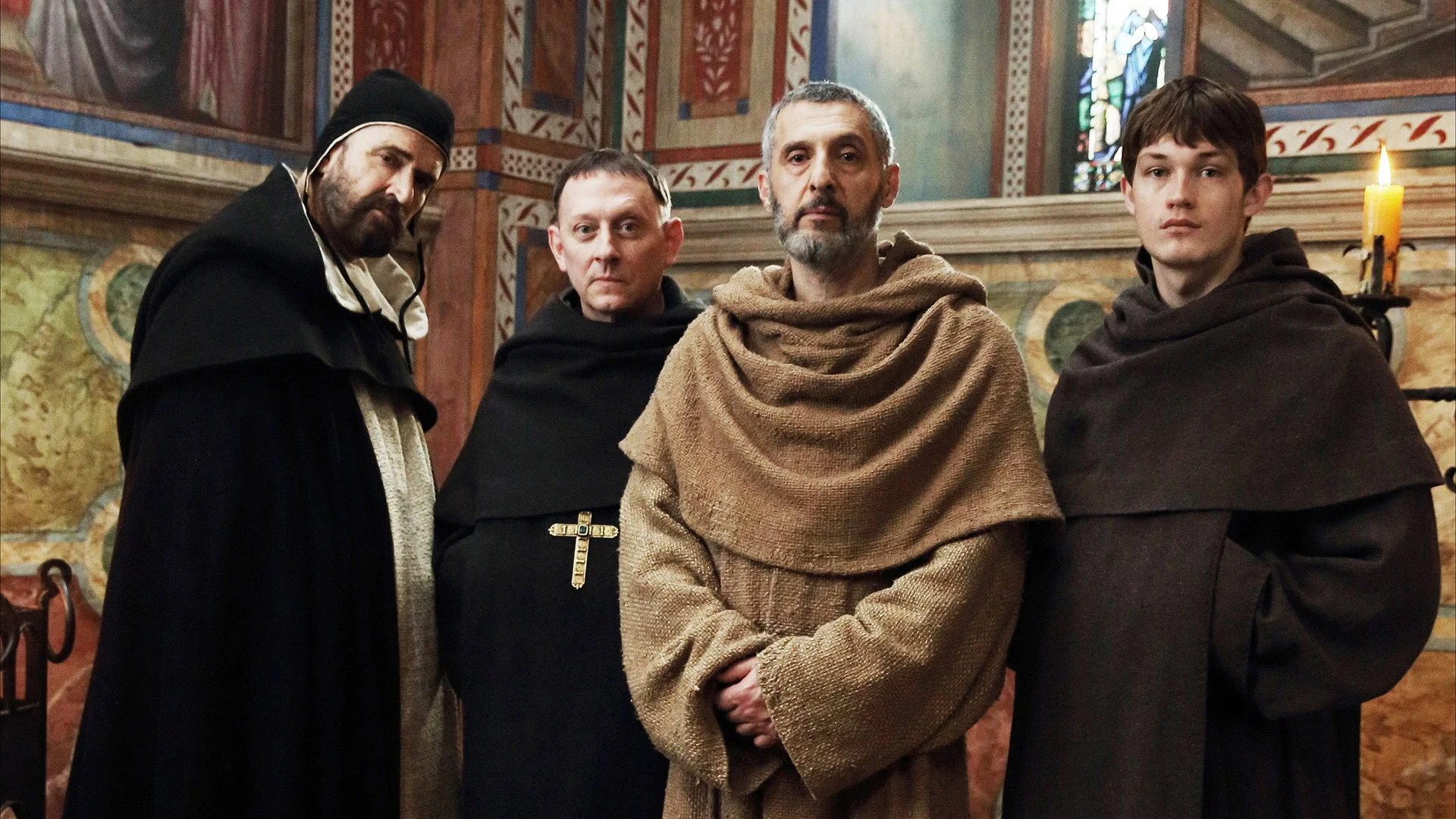
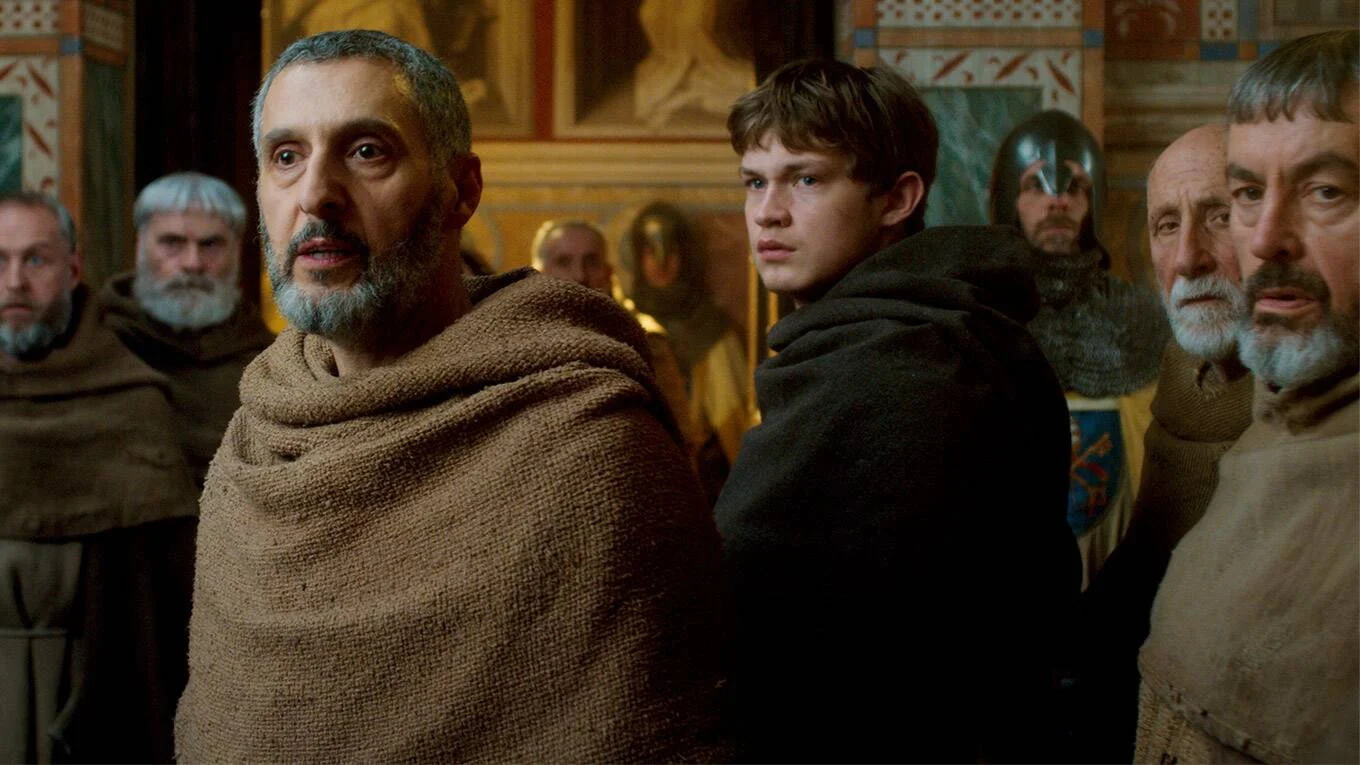
Behind the scenes
The abbey that
never existed.
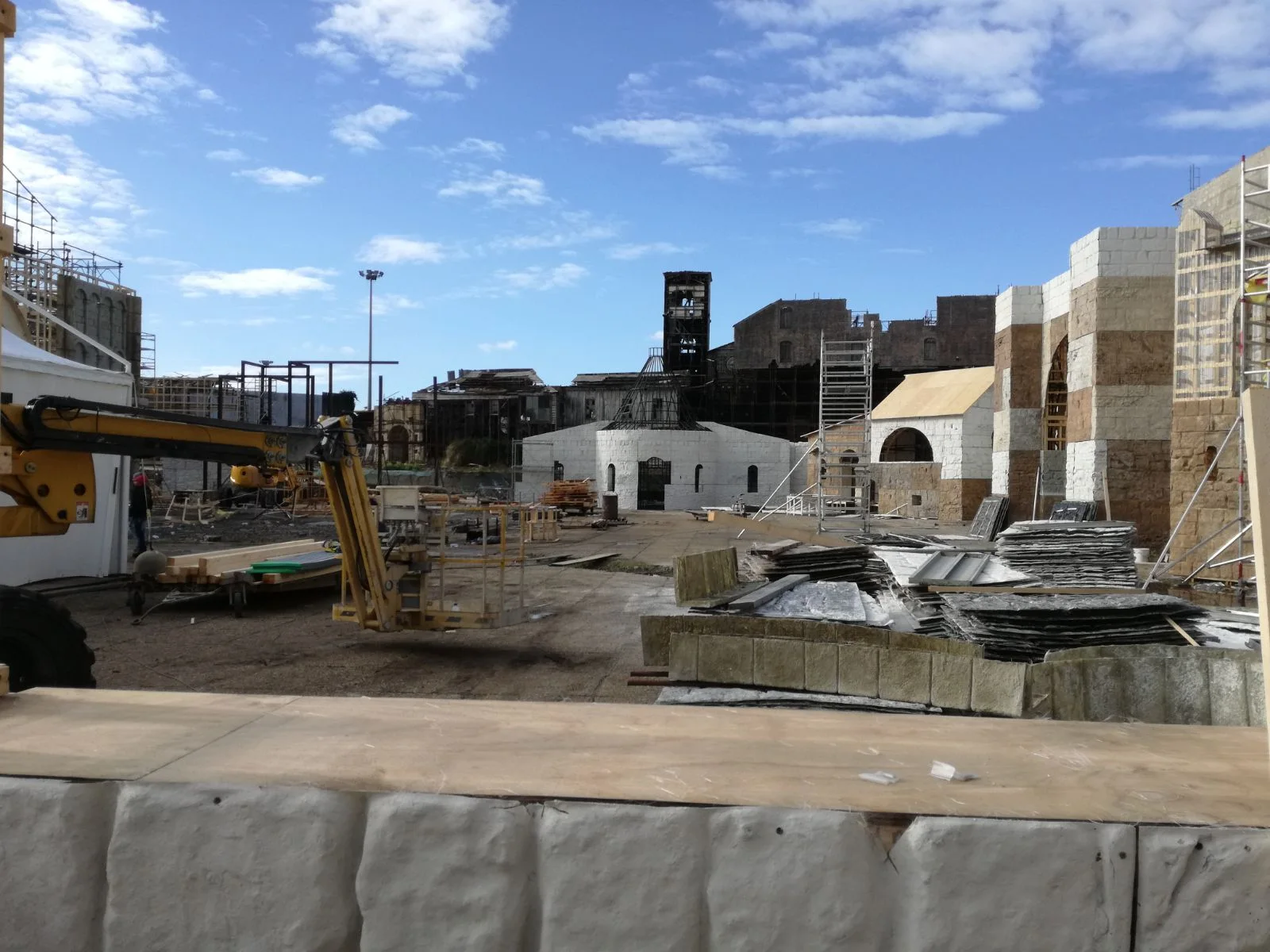
Eco's abbey is a literary place: no Italian Benedictine monastery matches the map the novel describes. For the series, the production chose to build the abbey from scratch at Cinecittà, combining two levels: an outdoor backlot with walls, towers and entrances seen from outside, and three interior sound stages with cloister, halls, library, cells and scriptorium. We worked on the scenography throughout 2017, ready in time for the 2018 shoot. For natural exteriors — the village, the streets, the distant monastery — the crew shot in Abruzzo (Roccascalegna, Hermitage of Santo Spirito a Majella), Umbria (Perugia, Bevagna, Montelabate) and Lazio (Vulci, Manziana, Torri in Sabina).
The outdoor backlot
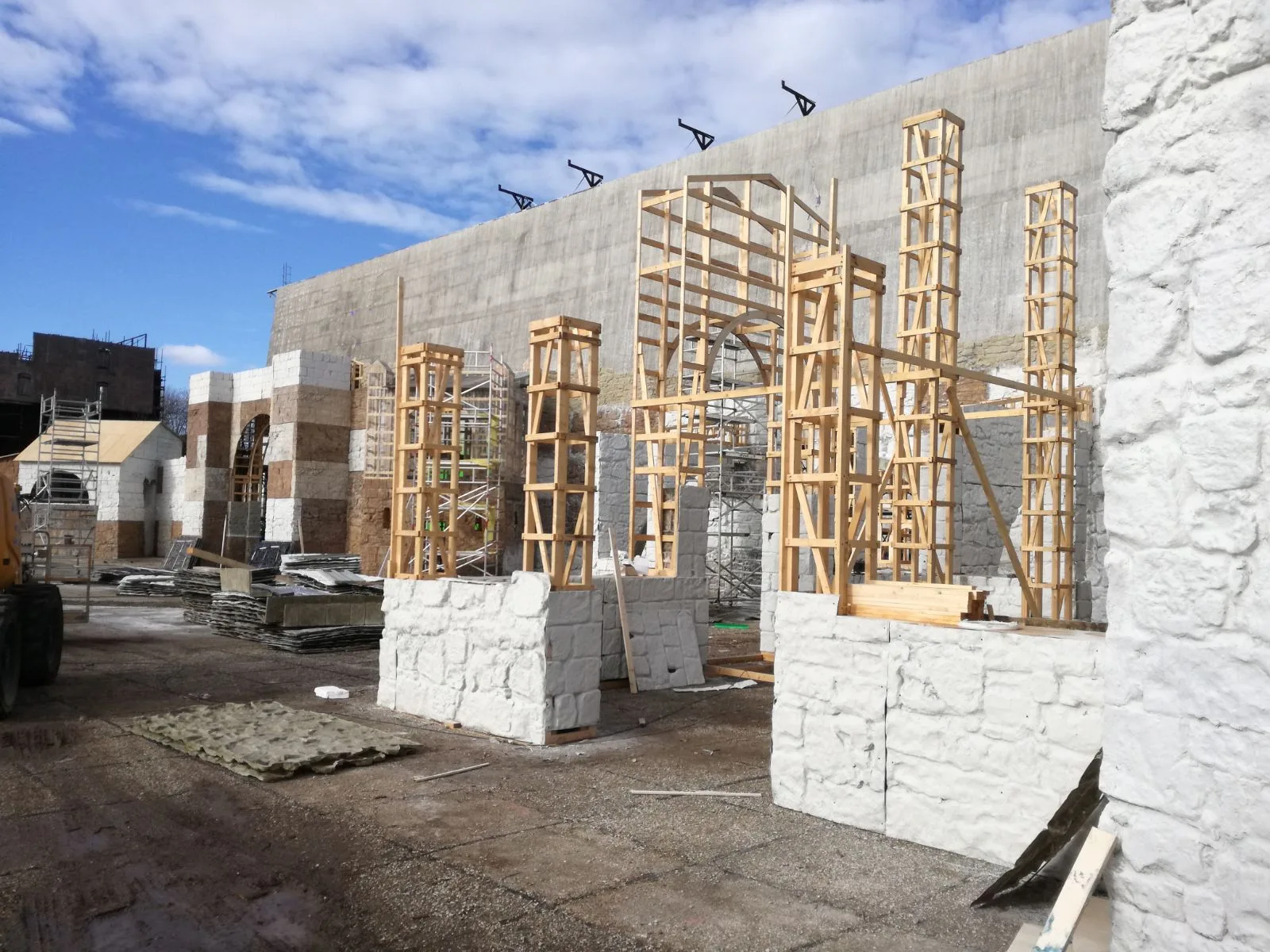
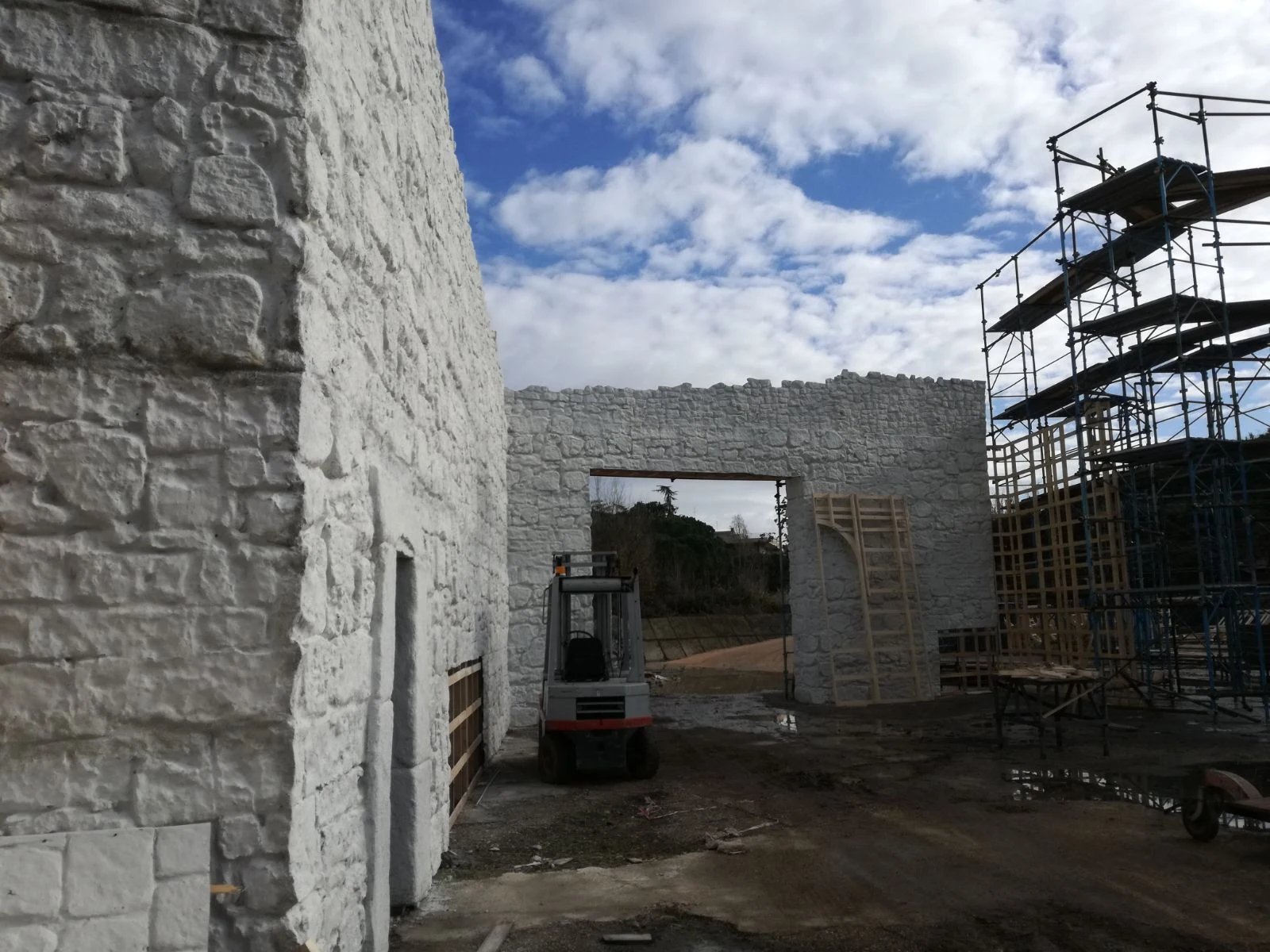
On the open-air backlot we built the exterior of the abbey: watchtowers, bell tower, perimeter walls, multi-level monastic buildings. The structures are in lightweight masonry patinated to look like ancient stone, mounted on a grid of scaffolding and timber to give depth to the overall view. Between one structure and another, the crane yard and the warehouse of modular pieces. From the air it looks like a small Italian medieval village.
The interiors in studio
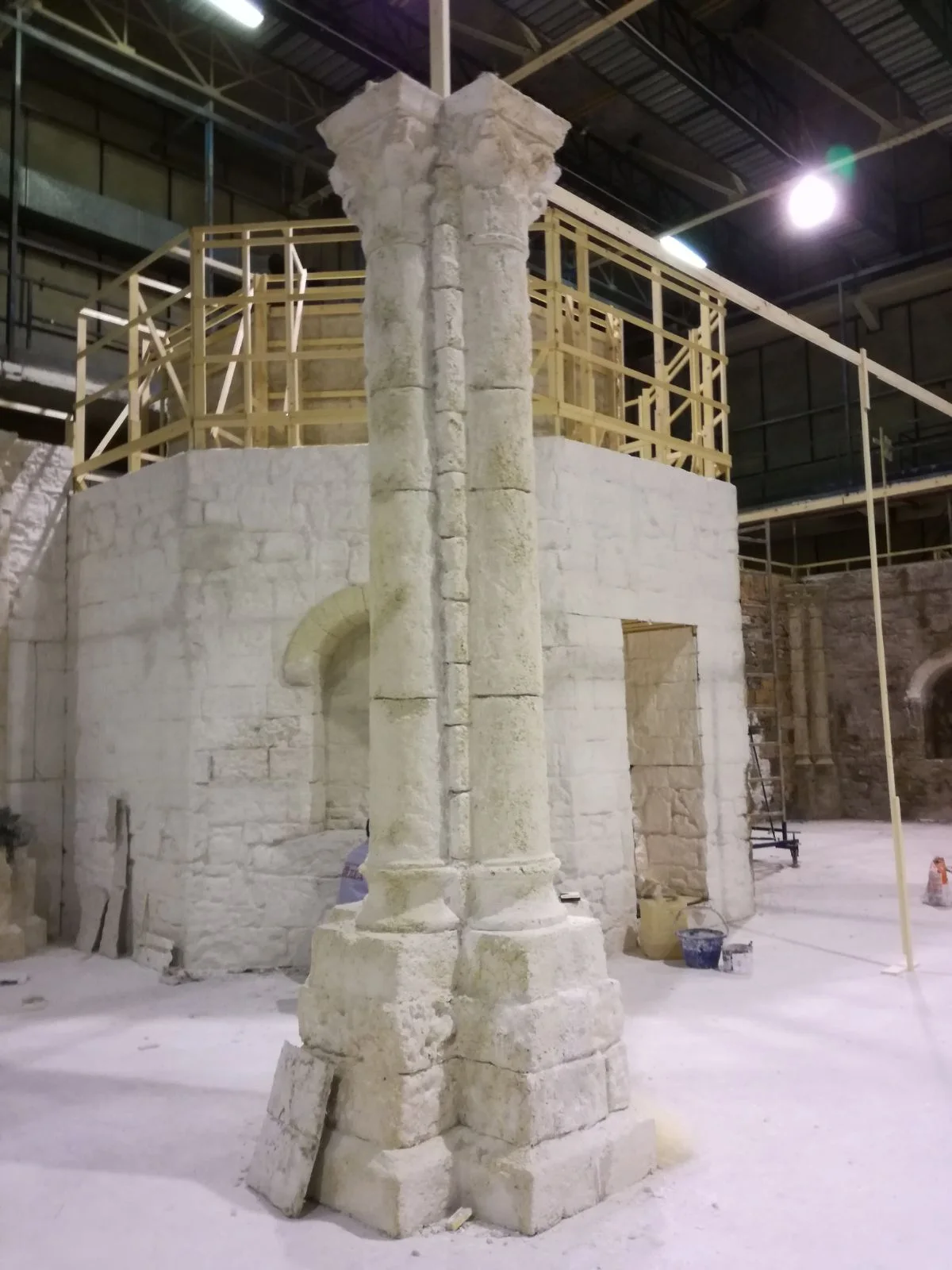
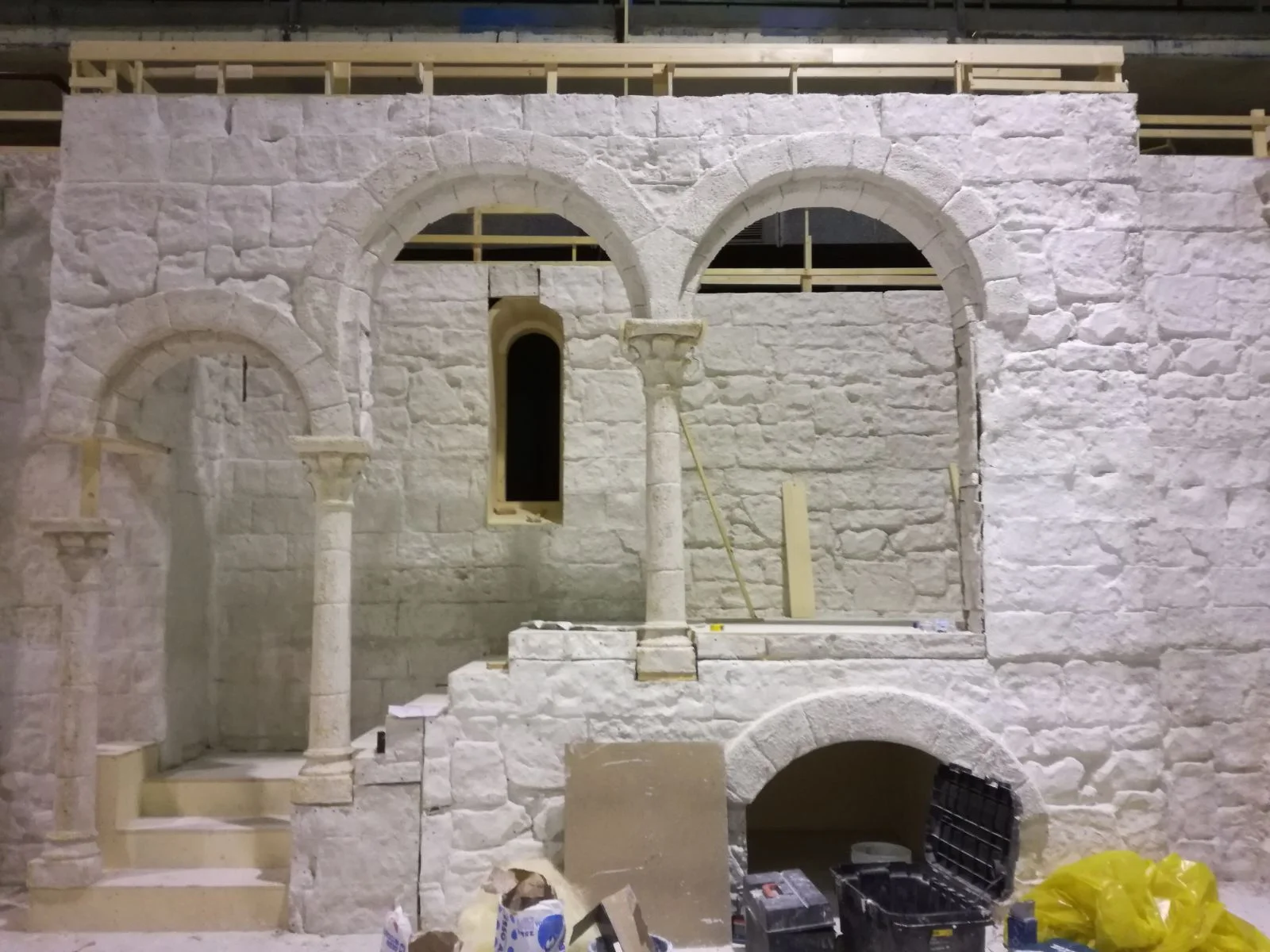
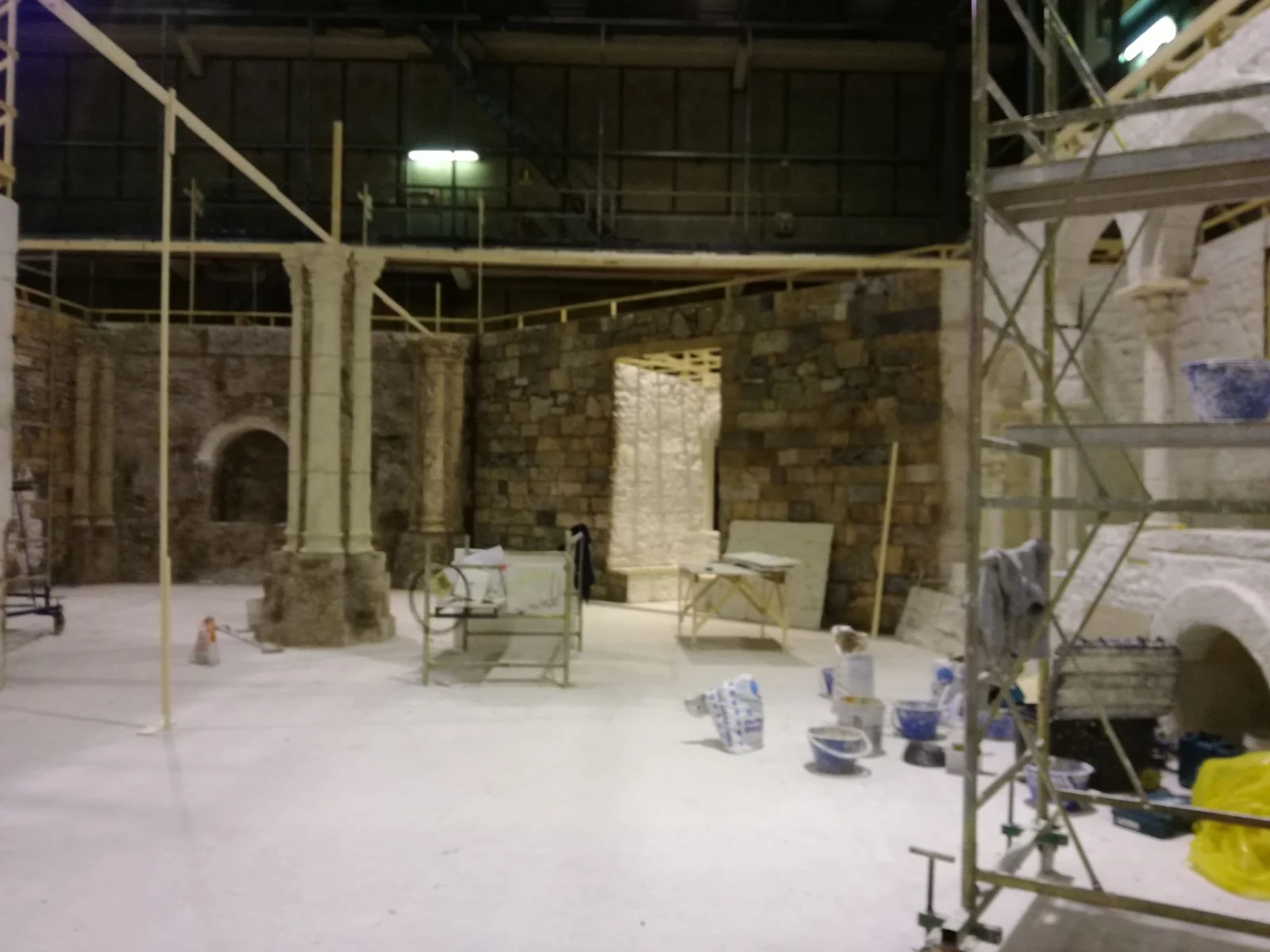
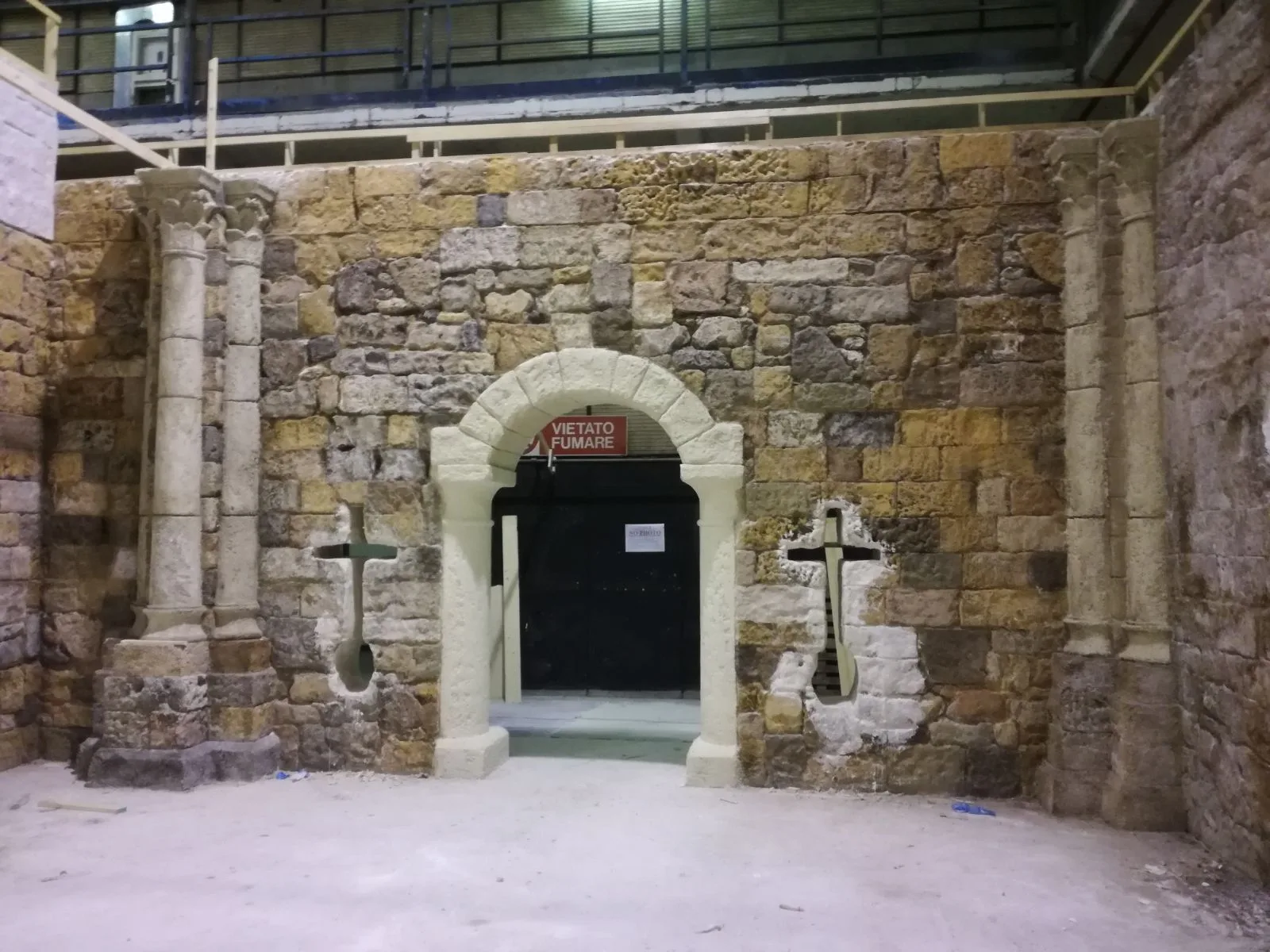
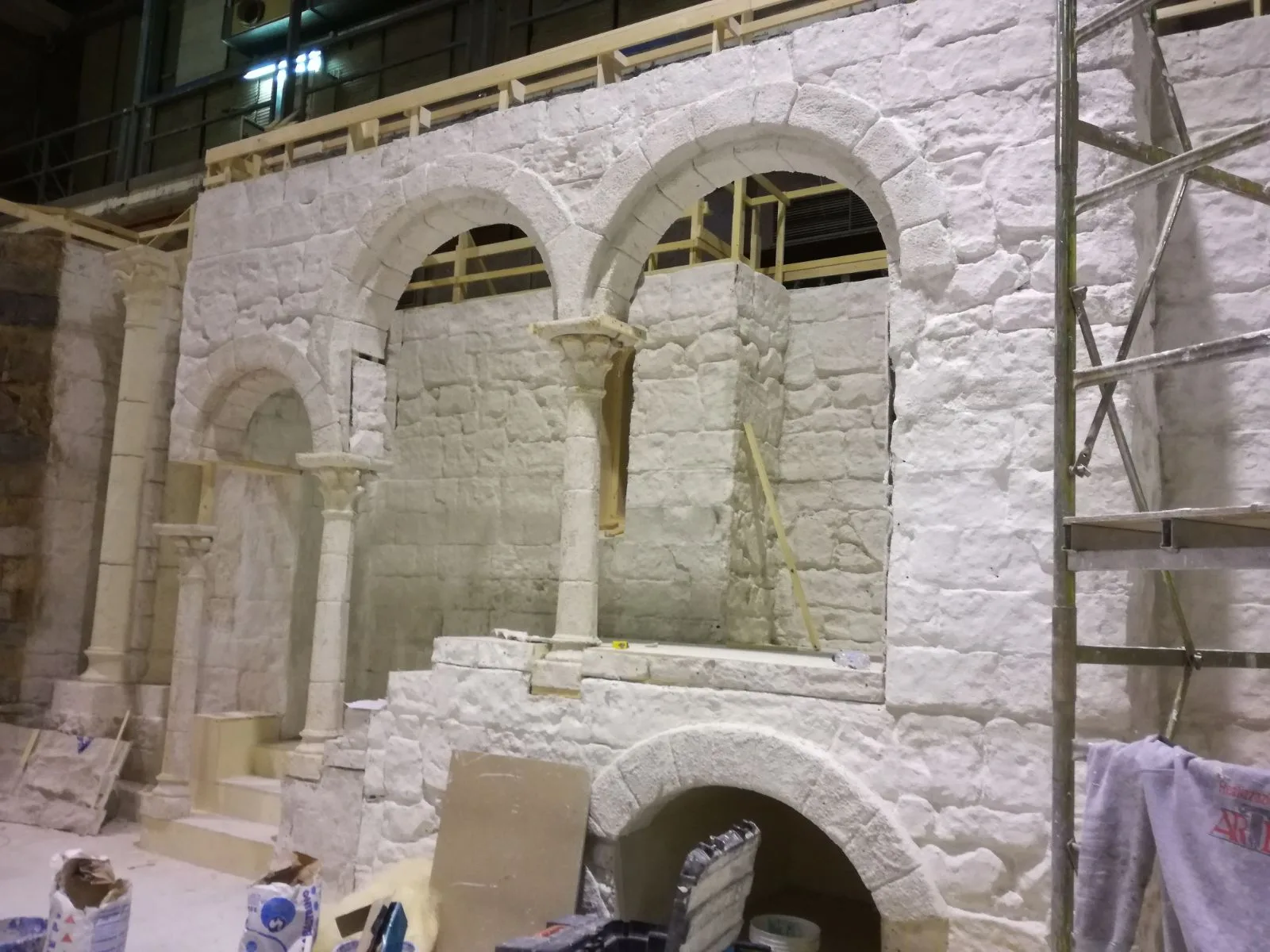
On the three interior sound stages we rebuilt the entire inhabited abbey: the cloister with twinned columns, the chapter hall with round arches, the monks' cells, the scriptorium, the frescoed chapel. Faux-stone columns carved to measure, Gothic three-light windows with central oculi, mullioned windows with knotted small columns, arched portals with frames. It's the Romanesque-Cluniac grammar, stone by stone, inside an industrial hangar.
The library, twice
"The fire of the Aedificium" is the key scene of the novel: the secret library of Jorge of Burgos burns, with the only remaining copy of Aristotle's Poetics on comedy inside. To shoot that scene, the library was rebuilt twice: the first time for normal shots (shelves, manuscripts, candelabra), the second in fireproof materials identical to the first in profile, to be set ablaze for real without ruining the "live" set. It's the level of craft you see on Game of Thrones, applied to an Italian TV drama.
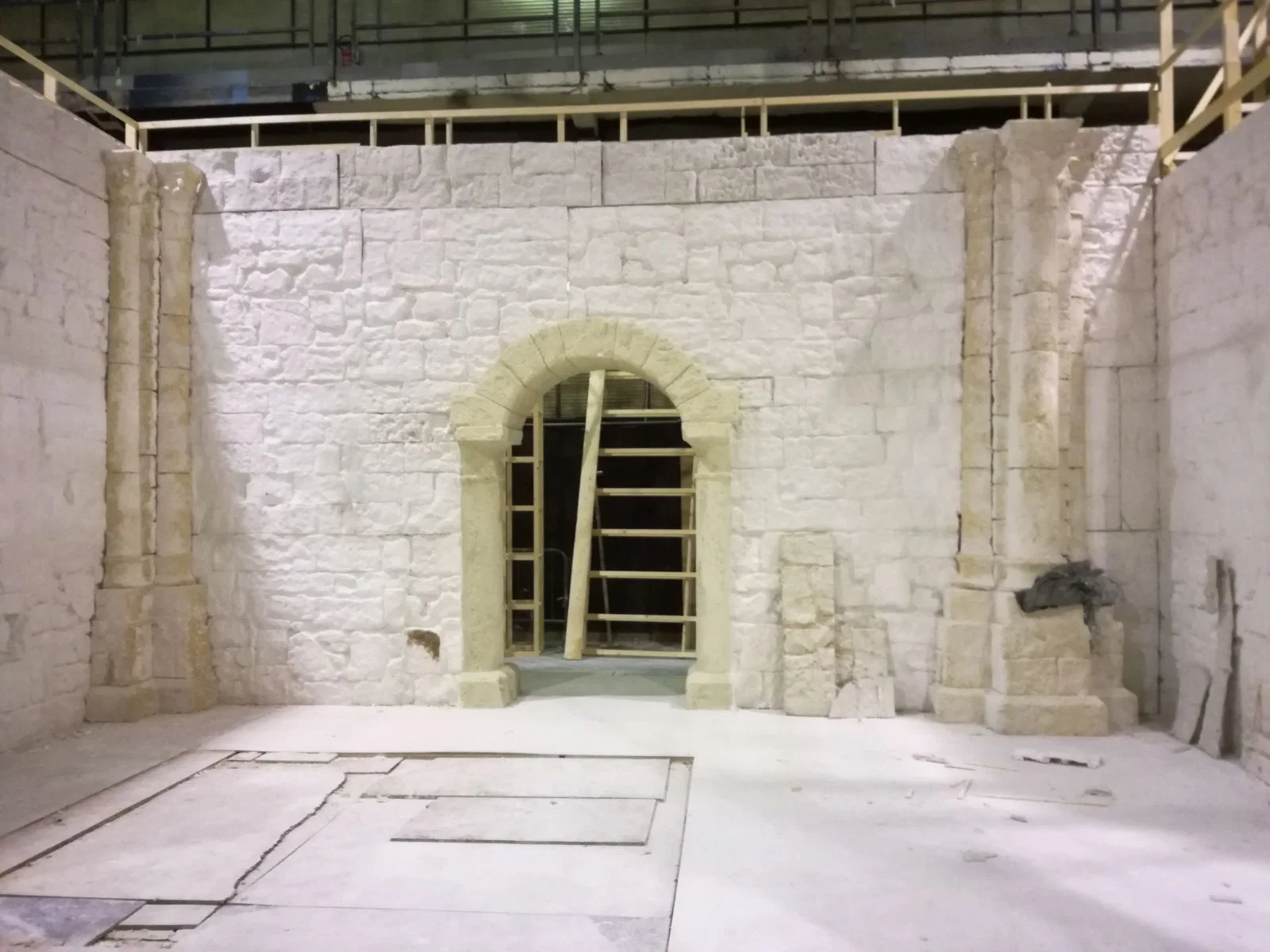
We took some liberties with the abbey:
we made it less harsh, drawing
on a rich and mature Gothic.
Tech sheet
Eight episodes, one season
The Name of the Rose by Giacomo Battiato is an 8-episode miniseries, aired on Rai 1 from 4 March 2019 over four evenings. Each episode runs between 49 and 56 minutes. Serialisation gives Eco's novel back its room for digression — the frescoes, the theological debates, the portraits of monks — that Annaud's 1986 film had been forced to compress into two hours of celluloid.
Four thousand square metres of abbey
The production opened three sound stages at Cinecittà Studios and an outdoor backlot of over 4,000 m². On the sound stages we rebuilt the cloister, church, chapter hall, refectory, scriptorium, cells, infirmary, forges, dormitories, stables. On the backlot, the abbey's exterior as seen from outside: towers, walls, entrances, bell tower. All in fibreglass, carved polystyrene and fibre-reinforced mortars, patinated to look like ancient stone.
One hundred and thirty-two countries worldwide
The Name of the Rose was sold in 132 countries — more than any other Italian TV drama of the decade after Gomorrah. On the main international broadcasters: BBC Two in the United Kingdom, SundanceTV in the United States, Sky Deutschland in Germany, OCS in France, SBS in Australia, KBS 1TV in South Korea. Confirmation that an abbey rebuilt at Cinecittà can tell the Middle Ages to the entire world better than many real castles filmed on location.
Twenty-six million budget
The Name of the Rose had a budget of 26 million euros, financed by the co-production between Rai Fiction, 11 Marzo Film, Carlo Degli Esposti's Palomar and Tele München Group. It's one of the highest budgets ever invested in an original Rai series. The scenography bore the signature of Francesco Frigeri — production designer who won the 2019 Globo d'Oro for Best Production Design precisely for this abbey.
All production data
- Type
- Television series · 8-episode miniseries · historical drama/thriller
- International title
- The Name of the Rose
- Based on
- "Il nome della rosa" by Umberto Eco (Bompiani, 1980)
- Direction
- Giacomo Battiato
- Screenplay
- Andrea Porporati · Nigel Williams · John Turturro · Giacomo Battiato
- Production designer
- Francesco Frigeri (Globo d'Oro 2019 · Best Production Design)
- Main cast
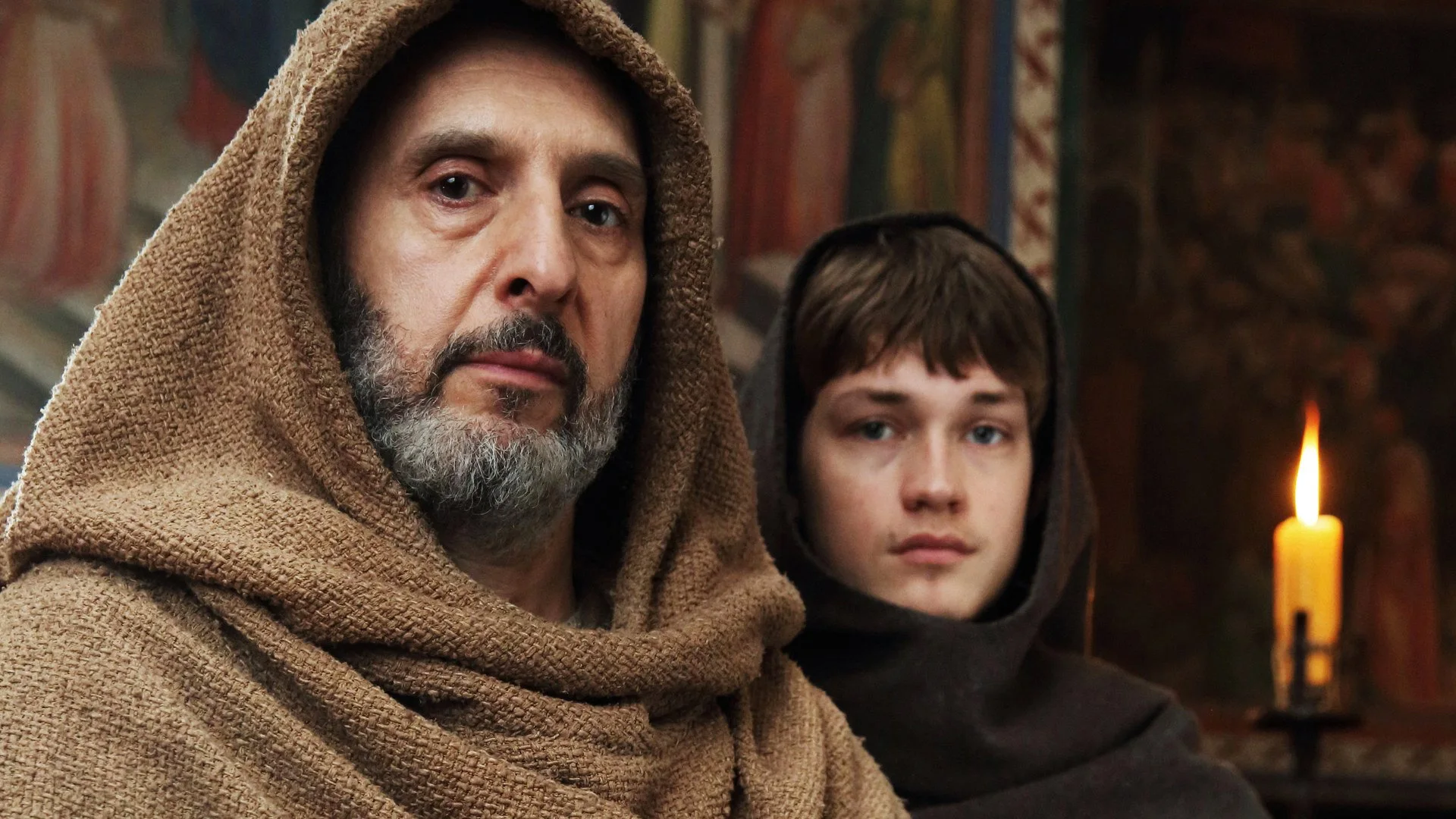
- John Turturro (William of Baskerville) · Damian Hardung (Adso of Melk) · Rupert Everett (Bernardo Gui) · Michael Emerson (Jorge of Burgos) · Greta Scarano (Anna)
- Production
- Rai Fiction · 11 Marzo Film · Palomar (Carlo Degli Esposti) · Tele München Group
- First broadcast
- Rai 1 · 4 March 2019 (4 evenings · 8 episodes)
- International distribution
- BBC Two (UK) · SundanceTV (USA) · Sky Deutschland (Germany) · OCS (France) · SBS (Australia) · KBS 1TV (South Korea) · sold in 132 countries
- Episode runtime
- 49–56 minutes per episode
- Budget
- 26 million euros
- Interior locations
- Cinecittà Studios, Rome · outdoor backlot + three sound stages, over 4,000 m²
- Exterior locations
- Abruzzo (Gole di Fara San Martino, Roccamorice, Hermitage of Santo Spirito a Majella, Roccascalegna) · Umbria (Perugia, Bevagna, Montelabate Abbey) · Lazio (Vulci, Tuscolo, Bracciano-Martignano-Manziana, Torri in Sabina)
- Our role
- Production of cinematic scenography in fibreglass, carved polystyrene and fibre-reinforced mortar for the outdoor backlot and the three sound stages: towers, walls and bell tower of the abbey, cloister with twinned columns, chapter hall, refectory, scriptorium, chapel, monks' cells, round-arched portals, mullioned and three-light windows with knotted columns. Built in 2017, ready in time for the 2018 shoot.
- The library-labyrinth
- Rebuilt in a double copy: a normal version and one in fireproof materials identical in profile, to film the final Aedificium fire scene without compromising the live set.
- Trivia
- Umberto Eco passed away in February 2016: he never saw this adaptation of his novel.
- Second life
- Abbey set dismantled after the shoot · some carvings (capitals, mullioned windows, portals) kept in our workshops as a medieval-school archive
Second life
The burned Aedificium,
the archive that remained.
The series The Name of the Rose by Giacomo Battiato aired in 2019 on Rai/Sky with great international following. The outdoor abbey scenography, the sound stage interiors at Cinecittà, the double-copy library-labyrinth (one standard and one identical fireproof for the final fire scene) were dismantled after the shoot.
Some of the most refined carvings — capitals, mullioned windows with knotted columns, round-arched portals in patinated faux stone — came back into our workshops as a medieval scenographic-school archive. The grammar of Northern European Romanesque-Gothic returns in every commission we take on for a film or series set between the 11th and 14th centuries.
Umberto Eco passed away in February 2016 — he never saw this adaptation of his novel. The series is, in effect, a posthumous tribute to his narrative work, built with the same philological patience with which Eco had built the book back in 1980.