
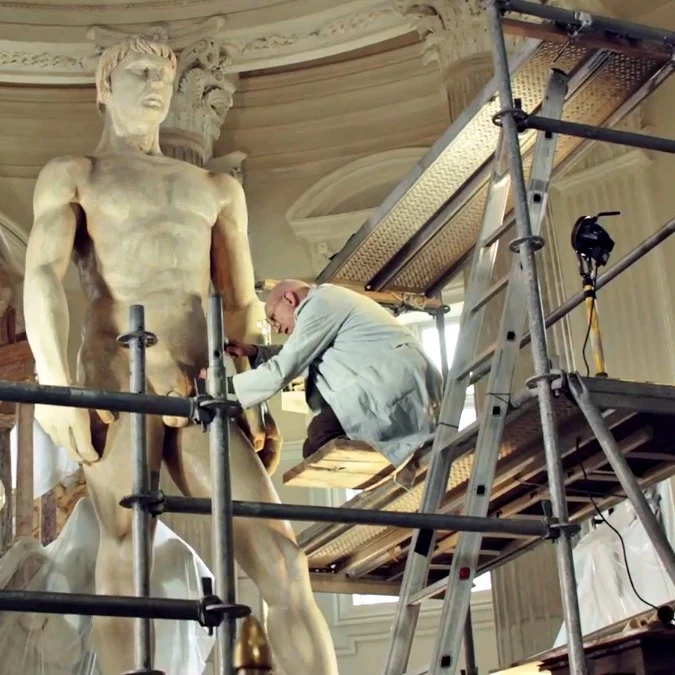
TV commercial · New Fiat 500 «The Fun-Size Review» · 2015
The Doryphoros and Chiambretti.
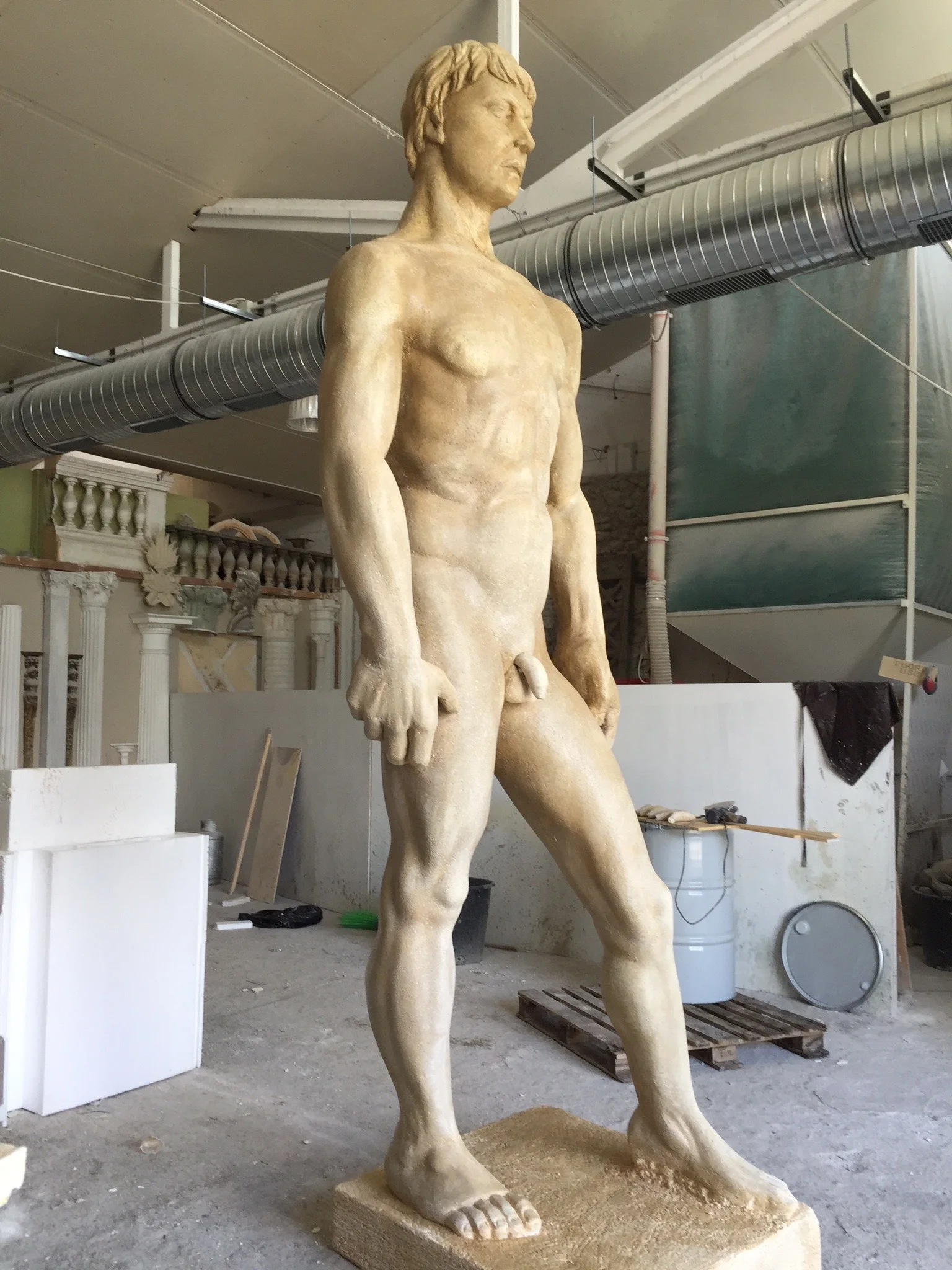
For the New Fiat 500 commercial with Piero Chiambretti — the 2015 spot poking fun at masculinity — we sculpted a life-size Doryphoros of Polykleitos, a copy of the classical Greek canon.
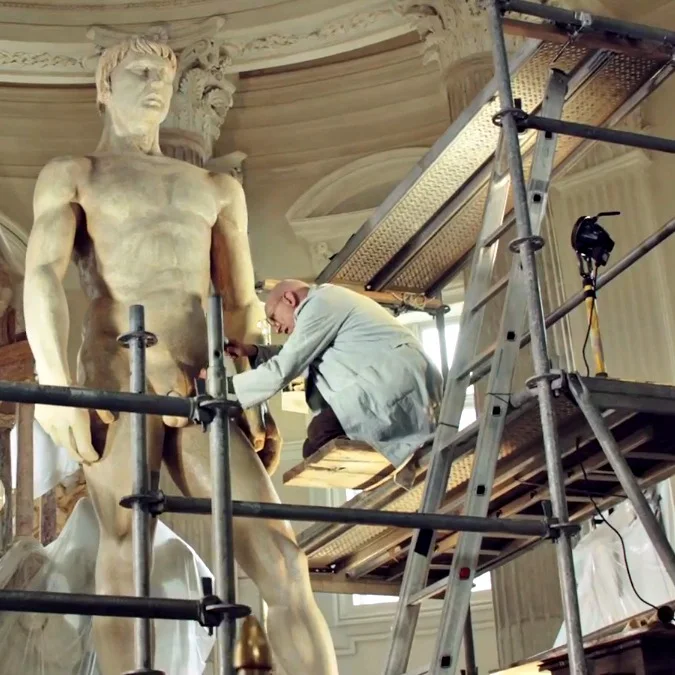
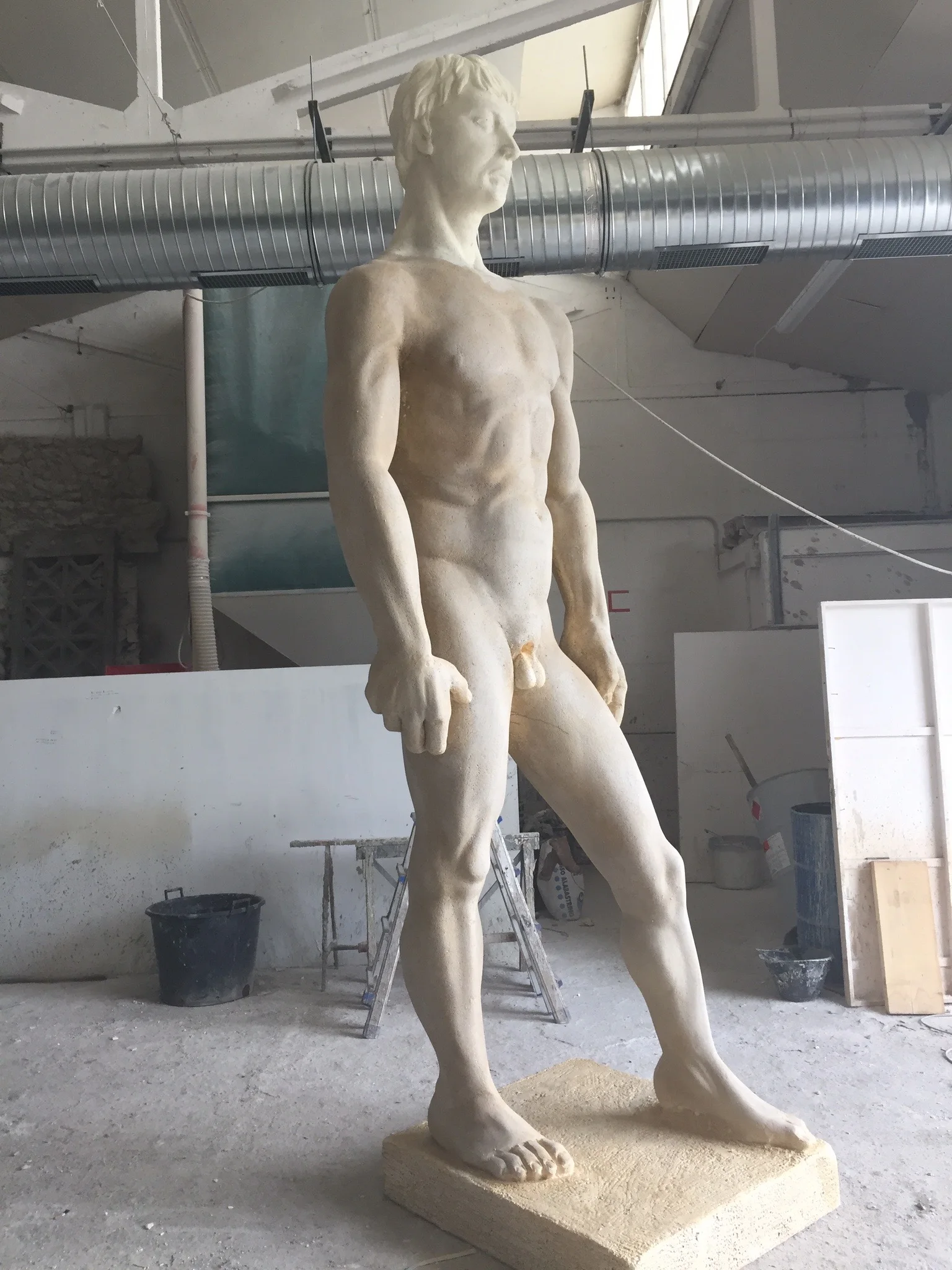
Behind the scenes
Polykleitos's Canon,
in 1:1 scale.
The Doryphoros is one of the most studied sculptures in Western art: it represents the ideal of physical perfection codified by Polykleitos in his (lost) treatise titled «Canon». Reproducing it at life size means honouring the mathematical rules of the original proportions.
The Polykleitan Canon
Polykleitos, a 5th-century BC Greek sculptor, wrote the Canon: a treatise that fixes the mathematical rules of the proportions of the human body. The core rule: total body height must be eight times the head height. The Doryphoros is the demonstrative statue of that treatise — the physical example of the theory.
The chiastic pose
The chiastic pose (X-shaped) is Polykleitos's invention: the tensed arm is paired with the opposite relaxed leg, and vice versa. The result is a sense of natural movement within a still figure — the end of archaic rigidity. The Doryphoros is the first Greek male nude that seems to breathe. Reproducing the pose is the core of the job.
The «amputatable» attribute
The director's specific request: the statue had to lose a piece during filming, in a controlled way. We engineered it with a calibrated breakaway fitting: the detachable piece is connected to the structure with a system that yields under targeted traction without damaging the rest of the sculpture. A technical solution at the service of an ad-spot gag.
1:1
the scale of the reproduction — life-size of the original Doryphoros
5th c. BC
the era of Polykleitos's original, a copy of the Canon treatise
1.5 M
Fiat 500s sold in the eight years before the 2015 restyling
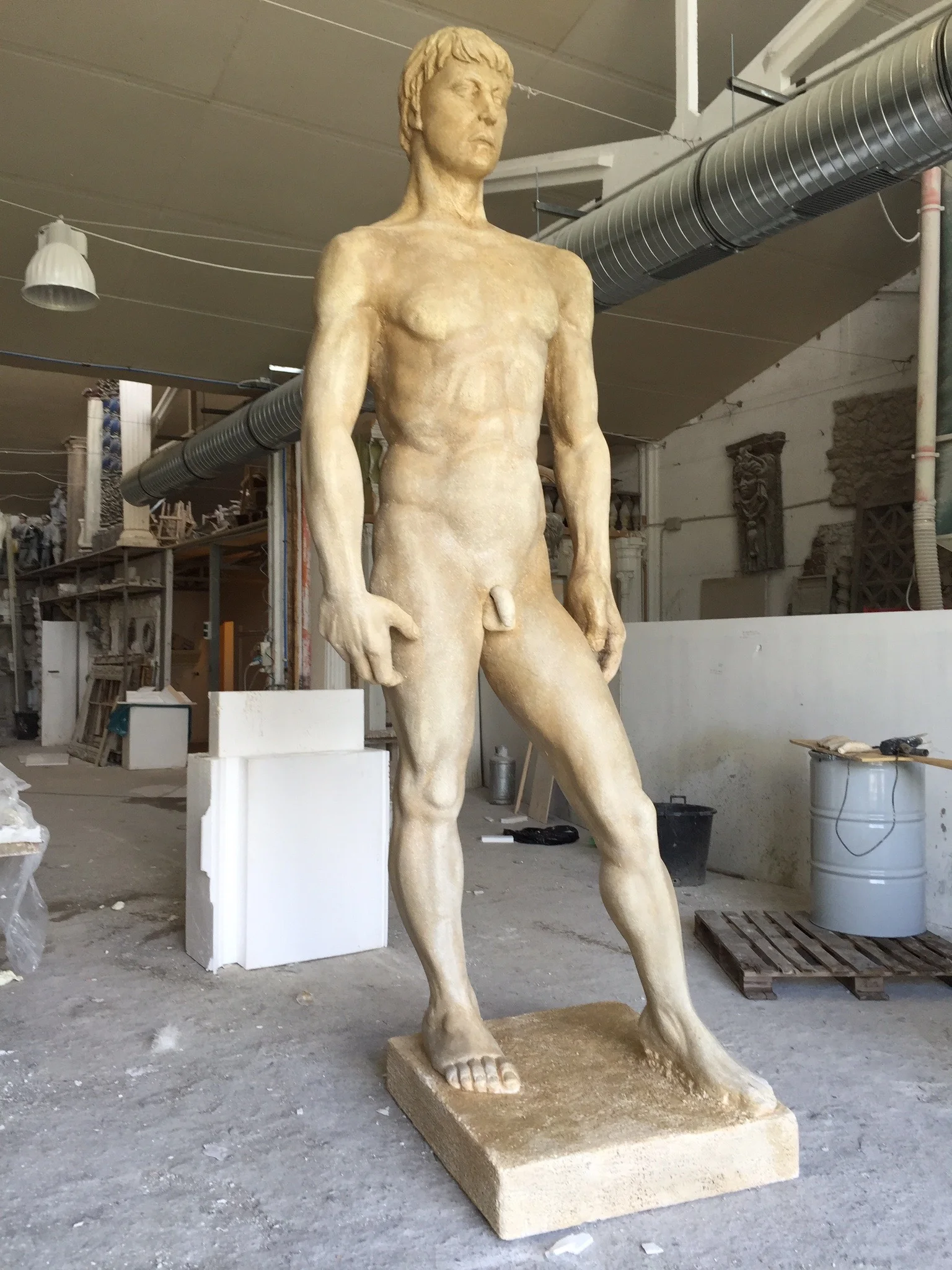
Workshop pieces
The statue in the workshop,
before the shoot.
Photos from our archive during the fabrication of the Doryphoros: sculpting, fibreglass stiffening, polychrome ivory finish, calibration of the detachable detail.
Second life
Classical statuary
in Italian advertising.
Classical statuary used ironically is a recurring cliché of Italian advertising — especially when the product is a citycar that wants to communicate lightness and self-deprecating humour. The 2015 Chiambretti commercial is one of the best examples of the genre: treating the Greek Canon as comic material, not as a monument.
Our Apuan-stone cast technique — developed in the same years for Konchalovsky's «Sin» and for the Peroni commercial — comes in handy on every commission that calls for a fake but credible classical sculpture at life size, delivered to set in a few days and removed at wrap with no trace left behind.
Tech sheet
All production data
- Type
- Scenographic sculpture for a TV commercial · reproduction of a classical artwork
- Commercial
- «The Fun-Size Review» · New Fiat 500 launch campaign · 2015
- Client
- Fiat · FCA Group
- Voice / performer
- Piero Chiambretti · voice-over and on-screen lead
- Sculpted subject
- Doryphoros of Polykleitos (copy of the 5th-century BC bronze original, preserved in Roman copy at the Naples Archaeological Museum) · sculpted at life size
- Pose
- Polykleitan chiasmus — left arm extended to hold the spear (absent in our copy, as in many Roman replicas), right leg weight-bearing, left leg relaxed in flexion
- Techniques
- Hand-sculpted expanded polystyrene · layered fibreglass stiffening · ivory lime-based base · surface patinated to imitate Apuan marble (same technique as the Carrara cast for Sin) · calibrated breakaway fitting for the detachable detail
- Theme of the commercial
- Irony about masculinity and size · same narrative line as the 500X «blue pill» commercial · final scene: «amputated» piece picked up by an elderly lady
- Our role
- Full sculpture build — sculpting, stiffening, polychrome finish, controlled-release system for the detachable piece, delivery to set
- Second life
- Statue removed at wrap · Apuan-stone cast technique applied to subsequent commissions