
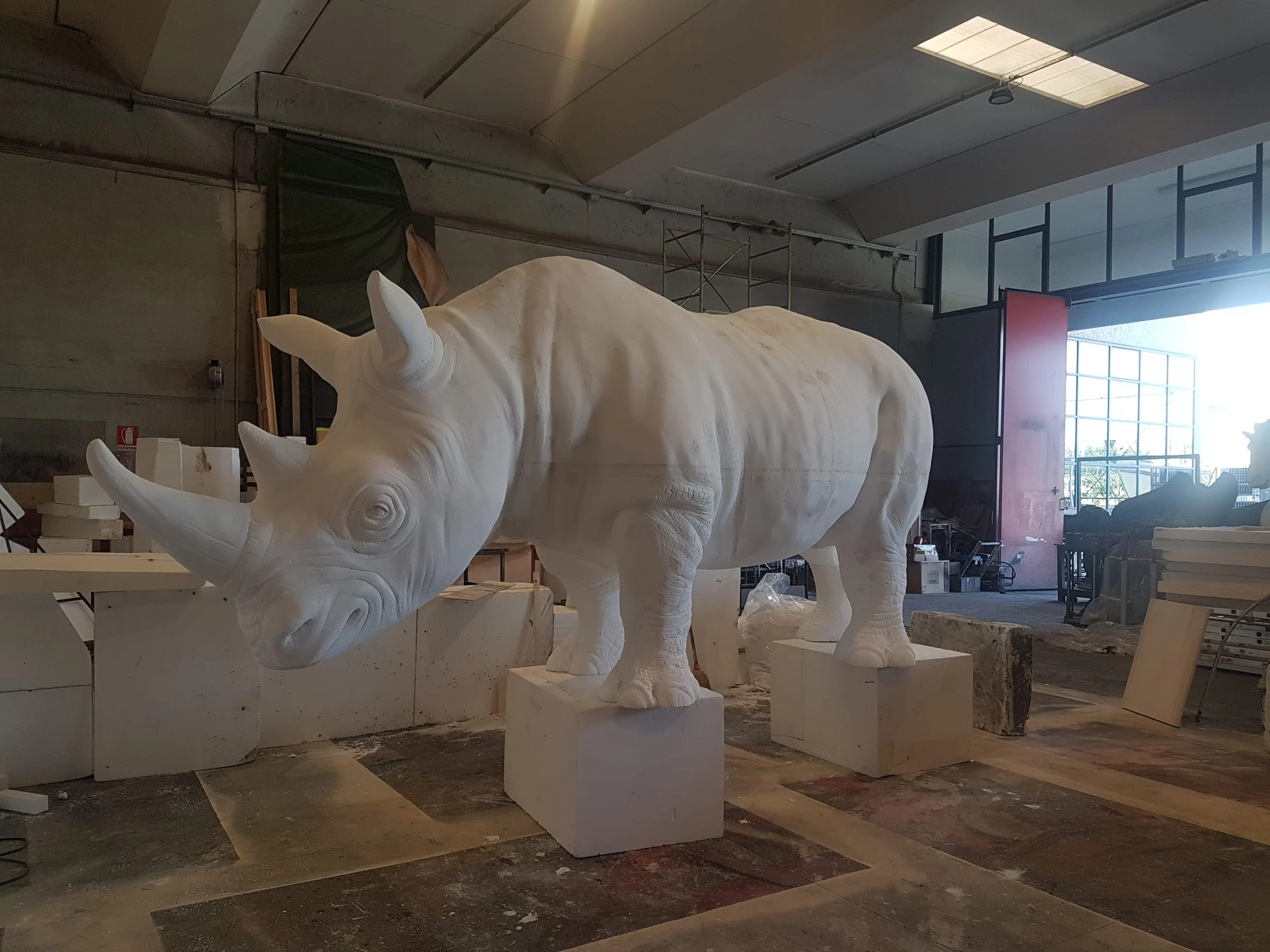
Fondazione Alda Fendi · Palazzo Rhinoceros · Rome · September 2018
Rhinoceros apud saepta.
The life-size white rhinoceros sculpted in our workshops for Fondazione Alda Fendi Esperimenti: the visual manifesto of Jean Nouvel's Palazzo at the Velabro, inaugurated beneath the Arch of Janus.
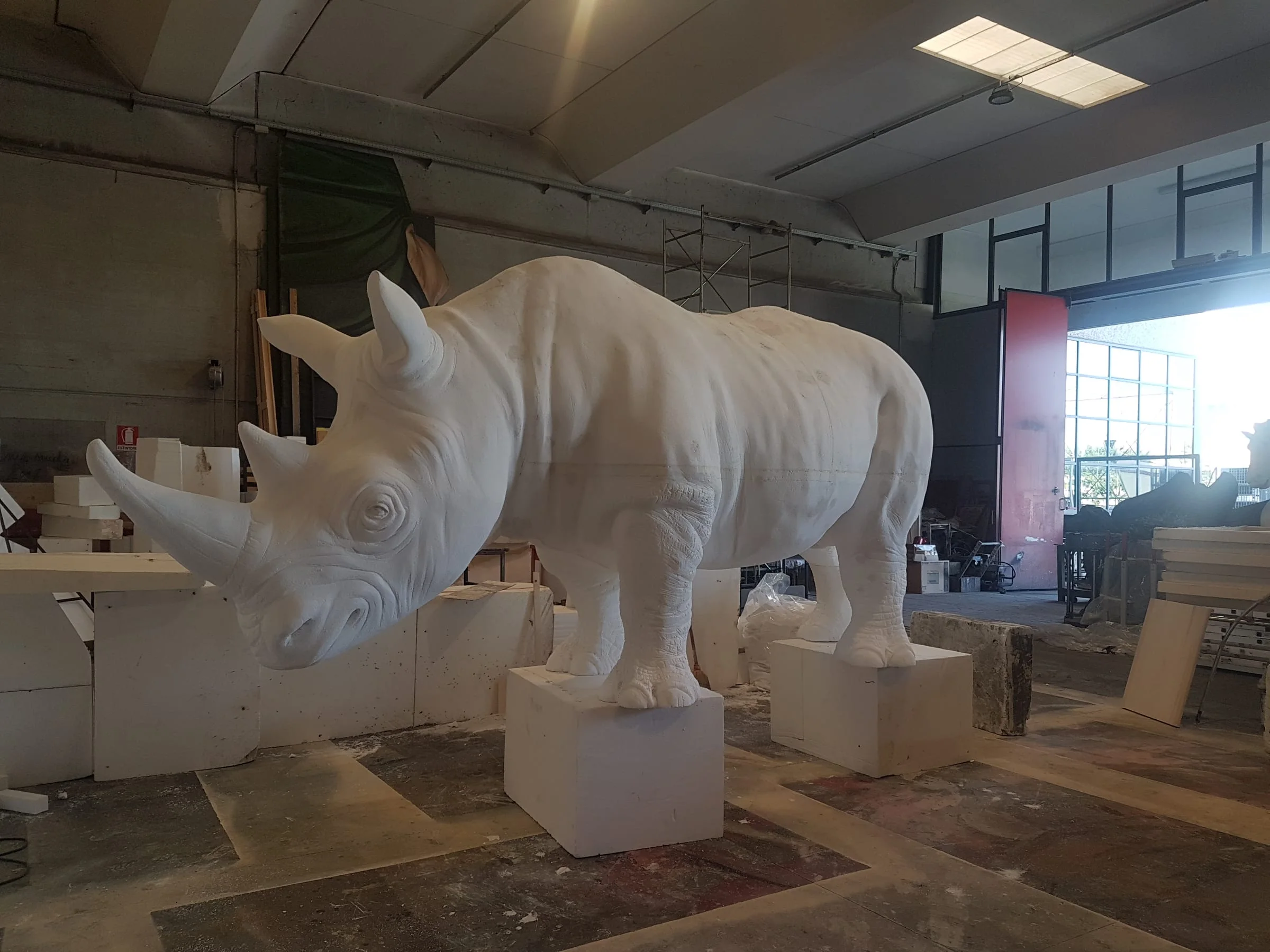
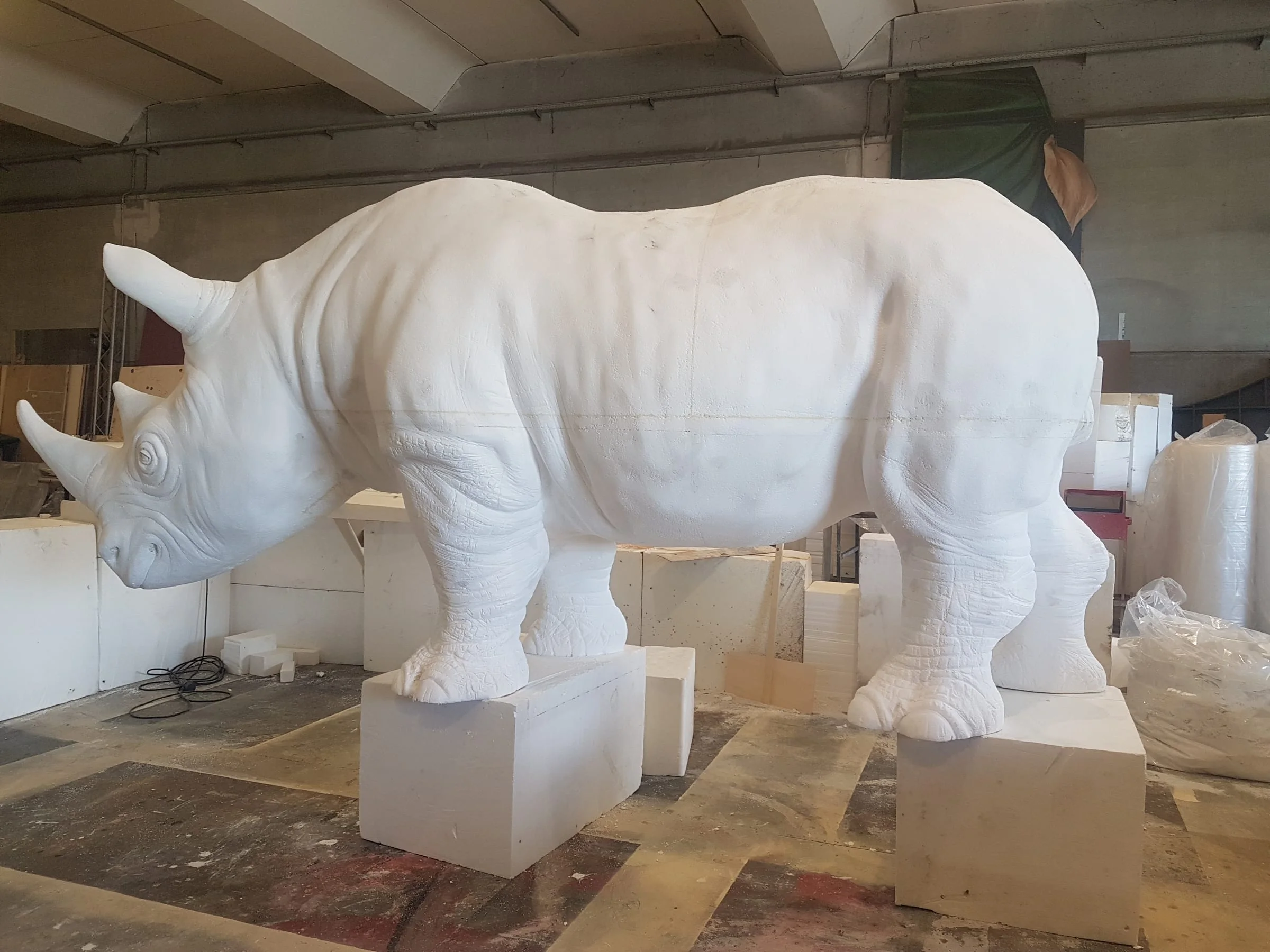
Behind the scenes · the three readings of the rhinoceros
Three messages
in a single animal.
Curi and Fendi don't ask for just any subject. The rhinoceros — a huge, primitive animal with thick armour and an independent character — condenses three overlapping readings: the reference to imperial Rome, the metaphor for contemporary art, the urban landmark for the Velabro.
1 · Imperial Rome
The placement is not accidental: next to the Arch of Janus and the Foro Boario. In ancient imperial Rome, rhinoceroses were among the rarest and most spectacular exotic animals brought to the city from the farthest lands to amaze the people during the games (Suetonius wrote about it). Placing a giant rhinoceros there today serves to recreate that sense of wonder from two thousand years ago.
2 · The metaphor for art
For the Foundation, the rhinoceros is the perfect metaphor for contemporary art: a primitive, nonconformist force that loves open spaces and can't be tamed. «Things are not as they appear»: despite its aggressive armour, it's a peaceful herbivore — it pushes the observer to look beyond the first impression, which is the main task of art.
3 · The urban landmark
From a practical standpoint, the statue is a landmark: a visual reference point of strong impact. In a monumental area dense with history, that surrealist touch immediately catches passers-by's eye, inviting them to stop, ask questions, step inside to discover the free art gallery within Nouvel's palazzo.
1:1
the scale — life-size white rhinoceros (up to 4 m long)
3,500 m²
the footprint of the Palazzo Rhinoceros cultural hub redesigned by Jean Nouvel
Storaro
Oscar-winning Vittorio Storaro on the lights of the inauguration and the Arch of Janus
Second life
The palazzo's
resident «guardian».
Once the inaugural event and the performance beneath the Arch of Janus were over, the rhinoceros was not dismantled: it became the permanent resident «guardian» of Palazzo Rhinoceros. Moved off the street for protection, today — depending on the artistic programming — it is found either in the Rhinoceros Gallery on the ground floor, or moved to the top floor onto the spectacular panoramic RoofBar terrace, where it greets visitors among the tables.
The Foundation's artistic programming entered the palazzo right after the opening, with the exhibition Istantanee dell'Assurdo — dedicated to playwright Eugène Ionesco and his celebrated 1959 play «Rhinoceros». The circle closes: the rhinoceros is not just an animal iconography, it is the Ionescan metaphor of the mass that transforms itself, of the armour that grows over people.
The monumental animal sculpture techniques applied here have entered our standard repertoire for other similar projects — the King Kong of Carthageland, the Maleficent dragon, the Winx statues of Rainbow MagicLand.
Tech sheet
All production data
- Type
- Monumental life-size sculpture for a cultural hub · inaugural event + permanent installation
- Client
- Fondazione Alda Fendi · Esperimenti · active in the cultural projects of the city of Rome since 2001
- Venue
- Palazzo Rhinoceros · Velabro · Rome · between the Arch of Janus and the Palatine Hill, opposite the Foro Boario
- Architecture of the hub
- Jean Nouvel · Pritzker laureate · restoration and redesign of a 3,500 m² Baroque complex
- Artistic direction of the rhinoceros
- Raffaele Curi · artistic director of Fondazione Alda Fendi
- Inaugural lighting
- Oscar winner Vittorio Storaro (and Francesca Storaro) — permanent lights on the Arch of Janus + neon signs of the event
- Inaugural event
- «Rhinoceros apud saepta» (later renamed «Rhinoceros AT Saepta») · large open-air urban performance at the Velabro · the rhinoceros placed directly beneath the Arch of Janus
- Related exhibition
- «Istantanee dell'Assurdo» · dedicated to Eugène Ionesco and his 1959 play «Rhinoceros»
- Subject sculpted
- African white rhinoceros at life size (up to 4 m long, 2 m at the withers) · standing pose, on four legs, two horns
- Techniques
- Hand-sculpted high-density expanded polystyrene · layered fibreglass stiffening · folds of the skin, detail of the legs and eyes sculpted by hand · matte white finish
- Historical reference
- Suetonius in the Life of Augustus recounts the astonishment of the citizens when the emperor showed a real rhinoceros at the Saepta Iulia
- Literary reference
- Eugène Ionesco, Rhinoceros, 1959 — the play that gives the Foundation the title of the inaugural exhibition
- Our role
- Complete construction of the sculpture from Raffaele Curi's design concepts · sculpting, stiffening, finishing, transport to the site, installation beneath the Arch of Janus for the performance, subsequent transfer into the palazzo's rooms
- Second life
- Permanent resident guardian of the palazzo · today visible alternately in the Rhinoceros Gallery on the ground floor or on the RoofBar on the top floor · contemporary art gallery open free of charge to the public